
Wollaton Stump Grinding for Large Pine and Cedar Root Plates
- NPTC-certified for chainsaw, aerial tree work, and rigging and controlled dismantling -- not just stump grinding
- £5m public liability cover for work close to boundary walls, drives and mature trees
- George is on site from the first call to the final check, not a crew you never meet
Wollaton stump grinding jobs are rarely small. Between the plots backing onto Wollaton Park and the mature pine and cedar planting scattered through gardens around Wollaton Village and out towards Wollaton Vale, you're often looking at a root plate two or three feet across before the grinder even starts. That changes the maths compared with a typical suburban hedge stump: the wood is softer, the roots run wide and shallow rather than deep, and if there's a veteran oak or lime a few metres away, you need to know roughly where its roots sit before you touch the ground.
Grinding a stump like that isn't a five-minute job with a hire-shop machine. It's matching the machine and the grinding depth to what's actually in the soil, and knowing the difference between a stump that just needs mowing over and one that's about to have a new tree planted in the same spot.
What's Included When the Grinder Goes to Work
- Grinding the stump and visible surface roots down to a depth agreed with you on site -- typically 4-6 inches below grade for a lawn, deeper where you're replanting
- A machine access check for the long driveways, gated gardens and rear plots common on Wollaton's bigger properties, so the right size grinder gets brought first time
- Backfilling the hole with the ground mulch and chippings, or loading the spoil out if you'd rather not keep it on site
- Grinding several stumps in one visit where they're on the same plot -- common where a whole line of conifers or a mixed planting scheme has come down together
- Reducing the buttress roots and root flare on wide pine and cedar stumps so the ground sits level rather than lumpy once the main trunk is gone
Not Included / Costed Separately
- Full root system excavation -- grinding takes out the stump and near-surface roots, not roots running metres out under a lawn or driveway
- Turf repair, reseeding or replanting -- we leave the ground graded and level, but putting grass or a new tree back in is a separate job
- Felling the tree itself if it's still standing -- that's tree surgery, and it has to happen before a stump grind can start
- Grinding where roots have grown into or under drains, foundations or a retaining wall without looking at that separately first
- Taking away large volumes of chippings if you want the lot removed rather than left as mulch -- that's arranged and costed on volume, not included as standard
Booking Through to a Level Lawn
- Call and initial description -- You tell us the stump's rough size, the species if you know it, and roughly how far it is from the house or boundary. Pine and cedar stumps get flagged for a bigger machine before anyone drives out, because the root plate is usually wider than the trunk suggests.
- Site visit and access check -- George or a member of the crew looks at the stump, checks for buttress roots and any nearby tree whose roots might run underneath it, and works out how the grinder actually gets from the road to the garden -- gates, steps and soft lawn all change the plan.
- Grinding depth agreed with you -- For a lawn that just needs mowing over afterwards, four to six inches below grade is normally enough. If you're planting a replacement tree or shrub in the same spot, we go deeper and wider so there's no old wood left underneath to rot and cause it to sink later.
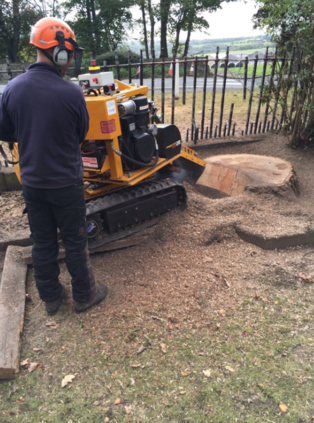
- The grind itself -- The grinder works the stump down through the agreed depth and radius, chewing through the root flare in passes. Pine and cedar resin clogs and dulls the cutting teeth faster than hardwood, so on a big softwood stump we budget more time on site rather than just bringing a bigger machine and expecting it to go faster.
- Clear-up and handover -- Chippings are either mounded back over the hole as a natural backfill or loaded out, depending on what you asked for. You're left with level, walkable ground, and George checks the finished job against what was agreed on the phone before we leave.
Pricing a Job at Pine and Cedar Scale
Most standard stumps in Wollaton -- garden trees, ornamental species, smaller conifers -- come in between £85 and £300, depending on trunk diameter and how much root flare there is to grind through. Where you've got a genuinely large pine or cedar stump, the kind with a root plate spreading well past where the trunk stood, that moves up to roughly £400-£710 or more. That isn't us padding the quote for a bigger species name: large-diameter softwood stumps generally sit at the top end of UK pricing because the wide, shallow root plate means more grinding passes and more time on the machine, whatever the wood itself is like underneath. Access counts too -- a stump three gates and a flight of steps from the road costs more to reach than one next to the drive. None of this replaces an actual look at the stump. Ring with the rough size and species and you'll get a working figure over the phone, but the number that sticks comes from someone standing next to the stump, not a guess from a description.
Garden Hardwood Stump vs a Wollaton-Scale Pine or Cedar Stump
| Typical garden hardwood stump | Large Wollaton pine or cedar stump | |
|---|---|---|
| Trunk diameter | Under 12 inches | 18 inches to 3ft or more |
| Root plate shape | Narrower, grows downward | Wide and shallow, often spreading past the old drip line |
| Grinding depth needed | 4-6 inches usually enough | Often deeper for replanting, plus a wider radius for buttress roots |
| Time on site | 30-60 minutes | Half a day or more on the largest specimens |
| Typical cost | £85-£300 | £400-£710+ |
Why a Big Wollaton Pine Doesn't Need Two Different Firms
On a Wollaton job, the tree work and the stump work are usually the same conversation rather than two separate phone calls to two separate firms. A big pine or cedar coming down near Wollaton Park is often felled, sectioned and ground out by the same NPTC-certified crew in one sequence: aerial work and rigging for the controlled dismantling, chainsaw work through the felling cuts, then the grinder for whatever's left in the ground. A fair few tree surgeons treat that underground half as someone else's problem and pass it to a subcontractor, which is usually where a job stalls waiting on a second company's diary to line up with the first. That's not how this one is set up -- George looks at the job on the first visit and comes back to check the finished grind, and the £5m public liability cover that applies to felling close to a boundary wall or a neighbour's fence line is the same cover in place once the grinder starts on what's left behind. George has talked about wanting a thirty-oak commercial clearance and a single garden stump treated with the same level of attention, which in practice means a large Wollaton pine stump gets worked properly rather than squeezed in as an afterthought once the tree itself is already down.
Where in Nottingham We're Out Grinding
Wollaton is one of the areas we're out to regularly, from the roads backing onto Wollaton Park and the woodland belt around Wollaton Hall's deer park, through to the newer estates further out towards Wollaton Vale and the Bramcote border. Big plots here often carry pine, cedar and other conifer planting left over from the same era as the park's own woodland, which is why oversized softwood stumps come up more often in Wollaton than they do on a lot of the terraced streets closer into the city centre. Day to day we're also across the rest of Nottingham, including Long Eaton, West Bridgford, The Park Estate, Beeston, Bramcote, Attenborough, Edwalton, Gamston, Ruddington, Bingham, Arnold, Woodthorpe, Carlton, Mapperley, Hucknall, and out to Southwell, Ravenshead, Derby and Mansfield, so if you've got a second property or a relative outside Wollaton itself, the same crew and the same NPTC-certified standard applies.
Questions Before You Book a Wollaton Stump Grind
How much does it cost to grind a large pine stump near Wollaton Park?
For a genuinely large pine, expect somewhere in the £400-£710+ bracket rather than the £85-£300 you'd pay for an average garden stump. Pine root plates spread wide and shallow rather than deep, so there's more diameter to grind through even though the wood itself is softer than an oak or beech stump of the same size. The exact figure depends on trunk diameter, how much of the root flare needs taking out, and how easily the grinder can reach it -- a call with rough measurements gets you a working estimate, but the firm number needs eyes on the stump.
Can stump grinding harm the roots of nearby mature trees?
It can, if it's done carelessly. Roots from mature trees often run further than the canopy suggests, and on Wollaton plots with a veteran oak or lime standing near a pine or cedar stump, those root systems can overlap underground even when the trees look well spaced above it. Before grinding close to a tree worth protecting, we look at which direction the neighbouring tree's roots are likely running and keep the grinding radius tight to the target stump rather than working the whole area flat. If there's real doubt about overlap, we'd rather flag it and grind a smaller radius than guess.
How do you grind a stump without damaging the surrounding woodland canopy?
Canopy damage on a stump job almost always comes from machine access, not the grinding itself -- a tracked grinder or trailer machine dragged through low branches to reach a stump at the back of a wooded garden. We check the route in on the site visit, and where access is tight, use a smaller machine that can get through gaps a full-size grinder can't, even if that means a longer job on site.
Is shallow grinding enough if I want to replant straight away?
Not really, if you mean planting in the same spot. Shallow grinding, four to six inches down, clears the stump for turf or a shed base, but leftover wood below that keeps rotting for years and can make new planting sink or struggle as its roots hit old timber. If you're putting a replacement tree or shrub where the stump was, tell us before the visit so we grind deeper and wider than the standard depth.
How deep does a stump grinder need to go for a cedar tree?
For a lawn area, four to six inches below grade clears most cedar stumps for normal use. Cedar tends to have a wide root flare rather than a deep taproot, so on a big specimen we're often grinding out sideways as much as down, working through the buttress roots at the base rather than chasing depth.
Do pine stumps take longer to grind than hardwood stumps?
Generally yes, but not because the wood is harder -- it's the opposite problem. Pine and cedar are resin-heavy, and that resin clogs and dulls the grinder teeth faster than a dry hardwood stump like oak or beech, so we're stopping to clear the cutting wheel more often. Combined with the wider root plate typical of softwoods, a large pine job can easily take twice as long on site as a hardwood stump of similar trunk diameter.
Can you grind multiple stumps in one visit for a discount?
Yes -- if there's more than one stump on the same plot, mention it when you call, because we can price the visit as a job rather than stacking separate call-out costs. Wollaton's bigger gardens often have two or three stumps from the same planting scheme coming down together, so this comes up regularly.
Could grinding stumps near Wollaton Park's historic parkland boundary require consultation with the council's parks and countryside team, even on private land?
On your own private garden, no -- grinding a stump on land you own doesn't generally need council sign-off just because it backs onto the park. Where it can get more involved is if the tree that produced the stump, or others nearby, were covered by a Tree Preservation Order or the property sits in a conservation area, which does apply to parts of Wollaton near the historic parkland. That's a question worth checking with the council before felling happens, not at the stump stage, since a TPO covers the tree rather than what's left of it once it's down. If you're unsure, we'll talk through what we're seeing on site, but the definitive answer on any TPO or conservation area restriction has to come from the council.
How do you avoid disturbing bat roosts sometimes found in decaying pine stumps in wooded NG8 gardens before grinding?
A stump that's been dead and softening for a while can develop cavities that bats or other wildlife use, particularly in the shadier, wooded corners of NG8 gardens near established tree cover. On the site visit we look at the stump's condition -- soft, hollow or heavily decayed wood is treated differently to a freshly cut, solid one. If there's any sign of roosting -- droppings, staining, an actual bat -- the job stops until it's been properly checked, because bats and their roosts are protected by law regardless of whether the tree is still standing. It doesn't come up often on a stump ground within a year or two of felling, but it's exactly the kind of thing worth flagging on an old, long-dead one.
Get Your Free, No-Obligation Quote
Tell us a bit about the job and we'll come back to you with honest advice and a free quote — usually within 24 hours.
- NPTC-certified for chainsaw, aerial tree work, and rigging and controlled dismantling -- not just stump grinding
- £5m public liability cover for work close to boundary walls, drives and mature trees
- George is on site from the first call to the final check, not a crew you never meet
Or call 0115-647-2443
Get My Free Quote
Ready for a Site Visit
A big pine or cedar stump isn't something to price over the phone from a guess, and leaving it in the ground only means more decay, more chance of it interfering with drainage or a new planting, and a harder job later once it's had longer to settle into the soil. Ring with the size and roughly where it sits on the plot, and George or the crew will come out to look at access, the depth you actually need, and what's growing nearby before anything's agreed.
Stump Grinding and Stump Removal Services
Call 0115-647-2443