
Air Spade Excavations Nottingham: Root-Safe Trenching and RPZ Investigation
- NPTC-certified operators handling the tree side of every root investigation, not just the digging
- £5,000,000 public liability cover for work carried out within touching distance of foundations and basement walls
- George involved from the first phone call through to the final site check, not handed off to a subcontractor
If you've been told you need a Root Protection Zone investigation before an extension goes ahead, or you've got a tree in visible decline and no one can tell you why, digging with a spade or a mini excavator is the wrong tool. Every cut through a root with a blade is permanent damage, and on a lot of Nottingham gardens sitting on shallow sandstone, a digger bucket does as much harm to the ground as it does to the roots. Air spade excavation uses compressed air instead of a blade to strip soil away from roots without severing them, which is why it's become the standard method for root investigation work near foundations, basements and buried services. We use it as an extension of work we already do underground — the same root system assessment we carry out before relocating a tree applies directly to air spade investigations, because both start with knowing exactly where the roots run before anything gets disturbed.
This isn't a bolt-on service we subcontract out when someone asks for it. George, who founded the business on stump removal before it grew into full tree surgery, still runs every job hands-on, and air spade work sits naturally alongside the root-level work the company was built on. If you're weighing up whether your project needs it, or you just want a straight answer about what compressed-air excavation can and can't do on your particular plot, read on.
Root collars, service runs and RPZ maps: what an air spade job covers
- Exposing roots around the root collar and root plate to diagnose girdling roots, collar rot or decay without cutting into them
- Clearing soil and old mulch build-up that's smothering the root flare and starving the tree of oxygen
- Locating and exposing buried drains, cables or ducting that run through a root system, so you know exactly what's there before anyone digs by hand or machine
- Trenching for a utility run, extension footing or driveway close to a tree, with roots left intact and simply worked around
- Root Protection Zone investigation and root mapping to support a BS5837 arboricultural report for planning or building control
- Decompaction and soil replacement where compacted ground close to a house or driveway is restricting root growth
- Photographic and written findings from the excavation, useful evidence if a tree officer or structural engineer needs to see what's under the surface before a decision is made
Not Included / Costed Separately
- Writing the BS5837 arboricultural impact report itself — we expose and map the roots, a qualified arboricultural consultant produces the planning document if the local authority requires one
- Repairing or replacing any drain, cable or duct we expose — that's a job for the relevant utility contractor or plumber, we just get you eyes on it without cutting through it first
- Structural assessment of subsidence or foundation cracking — we can tell you what a root is doing, not whether your foundations need underpinning
- Bulk groundworks or full-plot excavation — an air spade is precise and slow by design, it's not a substitute for a digger on a large-scale dig
- Fixed day rates quoted without a site visit — soil type, sandstone depth and access all change the time on site, so we won't guess a figure over the phone
- Work in frozen or waterlogged ground, which reduces how effectively compressed air breaks up the soil and can be pushed back a few days if conditions are against us
From first call to backfill: six stages of an air spade dig
- Initial call -- Tell us what's prompting the job — a planning condition, a tree in decline, an extension due to start, or a buried service you need to find safely. George or the team will ask about the tree species, its distance from the structure and whether there's already a survey or arb report in place.
- Site visit and ground assessment -- Before any air spade comes out of the van, we look at the actual ground — is it topsoil over Sherwood sandstone, heavy clay, or made-up ground from a previous build? Sandstone close to the surface changes how deep we can realistically expose roots and how long the job takes, so this gets checked on site, not guessed from a photo.
- Marking out and service checks -- We mark the excavation area and cross-check against any known utility runs before starting. If the job includes locating a drain or cable inside a root plate, this is where we agree the target area with you.
- The excavation itself -- The compressor and air lance break up soil into fine spoil while roots, cables and pipework are left physically undisturbed. Spoil is either bagged for removal or kept on site for reinstatement, depending on what you've asked for. This is the noisiest stage — a petrol or diesel compressor running for the duration — so we agree timing with neighbours in advance where the site is tight to a boundary.
- Findings and recommendations -- Once roots or services are exposed, we photograph and record what's there — root diameter, direction, any decay or girdling, exact depth to any service found. If the job feeds into a planning application, this record goes to whoever is producing the arb report.
- Reinstatement -- Exposed roots are protected and backfilled with suitable material, not just the spoil pile shovelled back in, and we talk you through any aftercare the tree needs before we leave.
Pricing an air spade job: why nobody quotes a flat day rate
You'll struggle to find a published day rate for air spade work anywhere in the UK — we checked, and none of the established arboricultural firms we're aware of quote one publicly, because the time on site depends on too many things that vary job to job. The clearest published benchmarks come from the US, where root investigation work using air spade equipment has been quoted in the region of $500 to $1,200 per tree, with day-rate figures around $1,800 turning up in trade discussion — useful as a rough sense of scale, but not a UK figure and not something we'd ask you to rely on. What actually drives the price on a Nottingham job is how deep you need to go, how much sandstone or compacted clay the compressor has to work through, how many trees or how long a trench run is involved, and whether we're bagging spoil for removal or reinstating on site. A single root collar investigation on one tree is a different job from trenching along a boundary for a service run. We'll give you a proper figure after seeing the ground, not before.
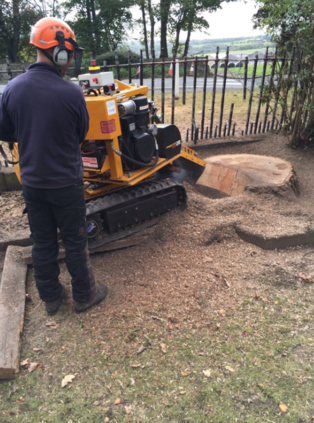
Air spade versus digging by hand or machine
| Method | Effect on roots | Safe near foundations/basements | Typical use |
|---|---|---|---|
| Air spade (compressed air) | Roots left intact and undamaged | Yes — the standard method for work within a metre of a wall | Root investigation, RPZ mapping, service location, decompaction |
| Mechanical excavator | Cuts or tears through roots in its path | Risky — vibration and impact can disturb shallow foundations and sandstone | Bulk groundworks away from tree root zones |
| Hand digging (spade/mattock) | Slower but still cuts through fine and structural roots | Safer than machine but still damages roots | Small jobs where an air spade isn't justified |
| Water jetting (hydro excavation) | Roots left largely intact, similar principle to air spade | Generally safe, but produces slurry that needs managing | Alternative where compressed air isn't practical, less common locally |
The team exposing your roots is the team that reads them
George's team runs air spade work themselves rather than subcontracting it to a groundworks or utility-locating firm, which is where this differs from how a lot of tree surgeons handle root investigation — a legacy of the stump grinding the business was founded on, when George started clearing stumps other firms left behind. The practical difference on an air spade job is that whoever's holding the air lance is also NPTC-certified in aerial and rigging work, so they know what a girdling root or an early sign of collar rot looks like the moment it's exposed, rather than a groundworker who's skilled at running the compressor but wouldn't necessarily flag what matters underneath. That's useful when the whole point of the job is diagnosis, not just moving soil. We carry £5,000,000 public liability cover, worth asking about directly if the work is happening within touching distance of a basement wall or foundation. And George's rule on scope is to expose only as much ground as the actual question needs — enough to see a girdling root, trace a drain run, or check a root collar for decay — rather than opening up more than the job calls for, because every extra hour a root sits exposed to air is an hour it's drying out for no reason.
Sandstone, clay and cellars: where air spade work concentrates in Nottingham
We're based at Long Eaton and cover Nottingham as the main area of work, with a lot of our root investigation jobs falling in the parts of the city where shallow Sherwood sandstone sits close to the surface — The Park Estate is the clearest example, where the same soft sandstone that Nottingham's cave network is cut into also means Victorian and Edwardian basements sit directly against bedrock, and root work there needs to account for stone as much as soil. West Bridgford and the older terraces around it have a similar mix of cellars and shallow foundations where we'd default to air spade over any mechanical dig. Wollaton and Bramcote tend to give us heavier clay rather than exposed sandstone, which changes how the compressor performs and how long a job takes. Further out, Ravenshead and Southwell sit on more open, semi-rural plots where root protection work is usually tied to a planning condition on a garden extension rather than a basement concern. We also cover Beeston, Attenborough, Edwalton, Gamston, Ruddington, Bingham, Arnold, Woodthorpe, Carlton, Mapperley and Hucknall, and take on jobs further afield in Derby and Mansfield where the ground conditions and the reasons for the work tend to be much the same.
Questions we get asked about air spade excavation
What exactly is an air spade and how is it different from digging by hand?
It's a tool that fires compressed air through a nozzle at high speed, breaking soil apart into loose spoil that gets blown or vacuumed away, rather than a blade cutting through the ground. A spade or mattock will slice through a root without you knowing it's there; compressed air moves the soil around a root and leaves it physically intact, which is the whole point when the job is to inspect or map roots rather than remove them.
Can air spade excavation be used safely near a house foundation or basement wall?
Yes, and it's generally the preferred method precisely because there's no vibration or impact against the wall the way there is with a mechanical excavator or breaker. That said, close proximity work is exactly where a site visit matters most — we need to see the actual wall, the depth of any basement, and how close the roots already run before agreeing what's realistic.
Does using compressed air to expose roots damage the tree at all?
Exposing roots to air always carries some risk if they're left uncovered too long, since fine roots can dry out. We keep exposure time as short as the job allows and protect roots that need to stay open for longer, then backfill properly rather than leaving bare soil to dry in the sun. Done properly, it's a fraction of the damage a cut root would cause.
Why would I need root investigation before building an extension?
If a tree sits close to where footings or a service trench are planned, a planning authority or your own structural engineer may want to know exactly where the roots run before work starts, particularly if the tree is protected or the site falls under a BS5837 condition. Air spade investigation gives you an accurate root map instead of a guess, which avoids redesigning foundations halfway through a build because a root turned up where nobody expected it.
Can air spading be used on sandstone or rocky ground in Nottingham gardens?
It works on sandstone, but the ground reacts differently to soil — sandstone that's soft and weathered breaks up reasonably well under compressed air, while harder or deeper stone slows the job down and can limit how far we're able to expose without switching methods. This is one of the main things we check on the site visit before quoting, since it directly affects time on site.
Is air spade work noisy or disruptive to neighbours?
The compressor itself is the noisy part — it runs continuously while the air lance is in use, similar to a generator or a petrol pressure washer. It's not a quiet job. On tight urban plots close to neighbouring gardens we'll talk through timing with you in advance, but there's no getting around the fact that a compressor running for several hours is audible.
Could an air spade be used to safely locate an old drain or cable buried among tree roots without cutting either?
Yes, this is one of the more useful applications of the tool. Where a drain run or cable is thought to pass through a root plate and nobody wants to risk hitting either with a spade, compressed air exposes both without cutting through them, so you can see exactly what's there before deciding how to proceed.
If sandstone bedrock is close to the surface in my Nottingham garden, will an air spade even work, or is it only for soil?
It's primarily designed for soil, and shallow sandstone changes what's achievable — we can usually still expose roots down to where the stone starts, which is often enough for an investigation or RPZ report, but excavating into the sandstone itself isn't what the tool is built for. We'll tell you honestly on the site visit if bedrock is going to limit the depth we can reach.
How long does a typical root protection zone investigation take?
A single tree with one or two areas to expose is usually a few hours' work. A longer trench run along a boundary, or an investigation covering several trees for a planning report, can run to a full day or more. It comes down to how much ground needs opening up and what the soil is doing underneath, which is exactly why we won't put a time or a price on it without seeing the site first.
Get Your Free, No-Obligation Quote
Tell us a bit about the job and we'll come back to you with honest advice and a free quote — usually within 24 hours.
- NPTC-certified operators handling the tree side of every root investigation, not just the digging
- £5,000,000 public liability cover for work carried out within touching distance of foundations and basement walls
- George involved from the first phone call through to the final site check, not handed off to a subcontractor
Or call 0115-647-2443
Get My Free Quote
Get your roots properly investigated before you dig
A planning condition, a declining tree or a buried service near a root system is a lot cheaper to sort out properly now than to discover halfway through groundworks, when a digger has already cut through something that mattered. Get in touch to arrange a site visit and we'll tell you straight what the ground is doing and what it'll take to investigate it without damage.
Stump Grinding and Stump Removal Services
Call 0115-647-2443