
Tree Felling & Dismantling in Nottingham
- NPTC-certified in aerial tree work, chainsaw operation, and rigging and controlled dismantling, not a general gardener with a chainsaw and a ladder
- Covered by five million pounds of public liability insurance, which matters when the job is a few feet from next door's conservatory or a shared boundary wall
- George is involved from the first phone call through to the final walk-round, not just the quote, with the cutting handed to someone else
When a tree in your garden has to come down and there's nowhere for it to fall in one piece, straight felling isn't an option. That's when tree felling and dismantling in Nottingham means something quite specific: climbing the tree and cutting it down section by section, lowering each piece on ropes so it never touches the fence, the shed roof, or the neighbour's greenhouse. Most of the felling and dismantling work we do around Nottingham falls into that category, because most gardens here are exactly that shape: enclosed, walled, backed onto someone else's boundary, and rarely offering the open drop zone that straight felling needs.
Where a tree does have genuine open ground around it, we'll fell it directly, because it's quicker and cheaper than rigging a piece-by-piece take-down for no reason. Deciding which method applies to your tree, and why, is what the site visit is for, and George looks at that himself on every job rather than sending a quote based on a photo.
What a Felling or Dismantling Price Actually Includes
- A site assessment before any saw touches the tree, covering overhead cables, whether the tree is protected by a Tree Preservation Order or sits in a conservation area, and everything within falling or swing distance
- Straight, directional felling where there's genuine open space to drop the tree in one controlled piece
- Sectional dismantling for confined gardens: climbing the tree and lowering cut sections on ropes past fences, sheds, greenhouses, patios, parked cars, and overhead lines
- Rigging and lowering gear set up to control the speed and landing point of every section, not just cutting and letting it drop
- On-site chipping of brash and small branchwood as the job progresses
- The trunk cut into rounds or logs, left stacked for you to use or split, or removed if you'd rather it wasn't there
- Ground protection, boards, or a rigging plank where the route to the tree crosses a lawn, patio, or driveway you don't want marked
- A clean-up and sweep of the work area once cutting is finished
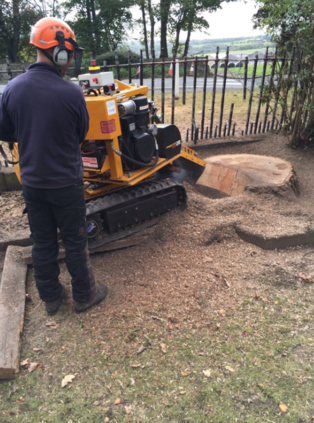
- The stump left flush and ready for grinding as a follow-on job, priced and booked separately
Not Included / Costed Separately
- Stump grinding itself isn't part of a felling or dismantling price - it's different plant and a different visit, though we'll happily quote both together if you want the whole job done
- Crane hire, for the rare tree where rigging alone can't handle the load or there's genuinely no ground access at all - this gets costed and agreed with you before it's added, not sprung on you mid-job
- Milling a trunk into usable planks or furniture-grade timber isn't a standard part of the service - sections can sometimes be left on site for you to arrange this separately, but it needs agreeing before the day
- Tip and disposal fees if you want every last round and offcut hauled away rather than left stacked for firewood
- Applying for Tree Preservation Order or conservation area consent - we'll tell you plainly if a tree looks protected, but the application itself goes through the council, not us
- Turfing, replanting, or general garden reinstatement once the tree and stump are gone
Reading the Lean, Setting the Rigging Points, Lowering It Down Safely
- The first call -- Tell us what you're looking at: the tree, roughly where it is in the garden, what's around it, and whether it's urgent (storm-damaged, leaning, dropping limbs) or something you're planning ahead for. You'll get a rough steer on the phone, but not a firm price, because that needs eyes on the tree.
- Site visit and assessment -- George, or one of the NPTC-qualified team, comes out to look at the species, condition, and lean of the tree, check for overhead cables, walls, sheds and greenhouses in the fall or swing zone, and check whether the tree is subject to a Tree Preservation Order or sits in a conservation area. This is where felling versus sectional dismantling gets decided, not guessed at over the phone.
- Written quote and method -- You get a price and, for dismantling jobs, a plan covering rigging points, the direction each section will be lowered, and what ground protection is needed.
- The work itself -- On the day, the area gets coned or barriered off, the climber sets up rigging while a groundsman runs the lowering ropes and feeds the chipper, and sections come down one at a time under control rather than in a rush.
- Clean-up and stump handling -- Brash is chipped, rounds are stacked or removed depending on what you asked for, and the site gets swept. If stump grinding was booked alongside, that's carried out once the felling team has cleared; if not, the stump's left flush and ready for it later.
- Final check -- A walk-round of the garden before the team leaves, so anything you're not happy with gets sorted there and then rather than after everyone's packed up.
Rough Numbers for Nottingham Gardens, and Why Access Changes Them
UK-wide cost guides put average tree felling and removal at somewhere around four hundred pounds, with the full range running from about one hundred and fifty pounds for a small tree up past two thousand five hundred pounds for a large, complex job. As a rough shape: small trees tend to fall in the one hundred and fifty to two hundred and fifty pound range, medium trees somewhere between three hundred and fifty and six hundred and fifty pounds, and large trees over fifteen metres can run past twelve hundred pounds. Stump grinding, if you want it done at the same time, is usually an extra eighty to three hundred pounds on top, depending on stump diameter and how deep it needs grinding. Where those figures don't tell the full story is access: a medium tree in an open field and the same tree wedged between a garage and a boundary wall with no vehicle access are not the same price, because the second one takes longer, needs more rigging, and may need everything carried out by hand rather than barrowed. That's why we won't give you a number worth relying on until someone's stood in your garden and looked at what's actually around the tree.
Straight Felling or Sectional Dismantling: Which Applies to Your Tree
| Straight (Directional) Felling | Sectional Dismantling | |
|---|---|---|
| Best suited to | Open gardens, paddocks, or land with a genuine clear drop zone | Walled town gardens, terraces, anywhere close to a building, fence, greenhouse, or road |
| How the tree comes down | Cut and steered to fall in one piece in a chosen direction | Climbed and cut into sections, each one lowered on ropes to a controlled spot |
| Time on site | Often a matter of hours for a single tree | A full day or more, depending on size and how tight the access is |
| What drives the price | Mostly the tree's size and species | Size, access, and how much rigging the job needs all add to the time |
Certified Rigging Work, Not Guesswork Over a Fence
Every dismantling job comes down to one read that happens before the saw starts: how the tree is leaning, how the root plate sits in the ground, and what that combination means for where the weight will want to go once a section is cut free. Get that wrong and a section swings the wrong way over a greenhouse roof or a shared wall; get it right and each piece comes down exactly where the rigging was set to put it. George does that reading himself on site, walking the base of the tree, checking which way the root plate is lifting or holding, and deciding from that where the rigging points go and which sections need breaking down smaller before they're lowered rather than after.
What sets a dismantle apart from most tree work is that the risk stays airborne for as long as a section is on the rope: a few hundred pounds of green wood swinging above a greenhouse roof or a shared fence, not anything happening down at ground level. NPTC's rigging and controlled dismantling qualification is built around exactly that problem, distinct from the general felling ticket, which is why it's the specific one George holds and applies on jobs like this. It's also why the five million pounds of cover earns its keep here rather than sitting unused: a section that swings off-line has a structure directly underneath it, not open ground, so the insurance is doing real work on a garden dismantle in a way it wouldn't on a straightforward fell in a field. George stays on site from that first read through to the section actually coming down, because the person who set the rigging point is the one who needs to watch it hold.
Terraces, Walled Plots and Wollaton's Old Oaks Across Nottingham
Nottingham is where most of this work happens, and the city's older suburbs are a big part of why sectional dismantling is our bread and butter rather than an occasional special case. Long, narrow Victorian gardens, high brick boundary walls, and terraces with no side access mean a tree often has to come down in pieces whether we'd prefer otherwise or not. We're based just south of the city in Long Eaton, which keeps response times short across West Bridgford, Beeston, and Bramcote. The Park Estate is a private conservation area with its own management scheme, and trees there are routinely covered by additional planning controls beyond a standard Tree Preservation Order, so we check that status before quoting rather than after. Wollaton's gardens often back onto mature parkland close to Wollaton Hall, meaning some of the oaks and limes we're asked to fell are genuinely large, old specimens rather than garden-scale trees. Attenborough, with its nature reserve and old gravel pits, has areas of wet, soft ground that changes how a job's approached, since waterlogged roots hold less than firm ground and can affect a tree's stability well before it looks obviously unsafe. Further out, we cover Ravenshead, Southwell, Edwalton, Gamston, Ruddington, Bingham, Arnold, Woodthorpe, Carlton, Mapperley, and Hucknall, and take on jobs further afield in Derby and Mansfield.
Felling and Dismantling Questions, Answered Straight
What's the actual difference between straight felling and sectional dismantling?
Straight felling is what most people picture: the tree's cut so it falls in one piece in a chosen direction, and it only works where there's clear ground for it to land on. Sectional dismantling is the opposite approach, used when there isn't that space. The climber goes up the tree and cuts it down in controlled sections, each one lowered on ropes to a spot the ground crew has ready, rather than letting any part of the tree fall freely. It takes longer and costs more for the same size of tree, but it's the only safe method once there's a fence, shed, greenhouse, or building within reach.
Can a large tree really be taken down safely in a small, enclosed garden?
Yes, and it's most of what we do. Size on its own isn't the limiting factor, access and what surrounds the tree are. A large tree in a walled garden with no vehicle access takes longer and needs more rigging points than the same tree in the open, but it's routine work for a team certified in aerial access and controlled dismantling, done properly with each section lowered rather than dropped.
Is directional felling ever used in a tight urban garden, or is it always dismantling once space is limited?
It comes down to whether there's a genuine clear drop zone, not just whether the garden looks small overall. Occasionally a tree sits far enough from boundaries and structures that a controlled directional fell is still possible even in a fairly compact plot. That's assessed on site, not assumed either way before someone's looked at it.
Do I need permission to fell a tree in my own garden?
Not automatically, but you need to check before booking work rather than after. If the tree has a Tree Preservation Order on it, or sits within a conservation area such as the Park Estate, you'll usually need the council's consent before any felling or significant dismantling work, and there can be a legal process and a waiting period attached. We'll flag it during the site visit if a tree looks protected, but confirming and applying is between you and the local planning authority.
How do you remove a tree without damaging fences, sheds, or a greenhouse right next to it?
By controlling every section as it comes down rather than letting gravity do the work. Rigging ropes are set through the tree so each cut piece is lowered to a chosen spot at a controlled speed, and ground protection goes down first if the route crosses anything you don't want marked. The alternative, cutting and dropping, is exactly what causes the damage people are worried about, and it's not how a dismantling job should be run.
What rigging is used to lower heavy sections when there's no room for a crane, like in a walled garden?
Rope and block rigging set up through the tree itself, using strong points higher up to control the speed and swing of each section as it's cut free and lowered. For heavier pieces, that might mean a lowering device that lets rope run under friction rather than free-fall, or breaking a large limb into smaller cuts before it's lowered at all, so nothing coming down is heavier than the rigging and the crew below can manage safely. Cranes only come into it on the rare job where rigging genuinely can't cope with the load, and that gets discussed and costed separately before it's added to the plan.
What happens if a tree's roots have grown into a boundary wall or a drain?
It changes how we assess the felling method and, sometimes, how the stump's dealt with afterwards. Roots bound up in a wall footing or wrapped around a drain run can make a tree less predictable when it's cut, since the usual root plate isn't behaving normally, so that gets factored into the felling plan on site. It can also mean stump grinding needs to be more careful near the affected section, working around the drain or wall line rather than through it, which is worth flagging to us before the day if you already know it's an issue.
If a bird's nest turns up mid-job, what happens to the work?
Work on that part of the tree stops. It's an offence under the Wildlife and Countryside Act to disturb an active nest of a wild bird, roughly across the March to August nesting season, and that applies regardless of whether the tree was already booked in. In practice, if a nest is found actively in use, we'll leave that section alone until the birds have fledged or a specialist confirms it's clear, and carry on with the rest of the tree if the job can be split that way. It's part of why booking outside nesting season, where the work isn't urgent, tends to go more smoothly.
Could sections from a felled tree be kept for garden furniture or timber, rather than chipped?
Sometimes, yes, if it's agreed before the day rather than decided halfway through. If you want particular sections kept whole, for example a trunk piece for a bench or slab, we can cut with that in mind and leave it on site rather than feeding it straight through the chipper. It's worth raising at the quote stage, since it changes how those sections get cut and lowered, and milling it into finished timber afterwards is something you'd arrange separately.
Get Your Free, No-Obligation Quote
Tell us a bit about the job and we'll come back to you with honest advice and a free quote — usually within 24 hours.
- NPTC-certified in aerial tree work, chainsaw operation, and rigging and controlled dismantling, not a general gardener with a chainsaw and a ladder
- Covered by five million pounds of public liability insurance, which matters when the job is a few feet from next door's conservatory or a shared boundary wall
- George is involved from the first phone call through to the final walk-round, not just the quote, with the cutting handed to someone else
Or call 0115-647-2443
Get My Free Quote
Book the Assessment Before a Storm Makes the Decision for You
A tree that's already leaning, dropping limbs, or showing dieback doesn't tend to wait for a convenient month, and if it's near a fence, shed, or your neighbour's boundary, the risk only grows the longer it's left. Nesting season also narrows your options between March and August, so booking a routine fell or dismantle outside that window usually means a simpler job with fewer constraints. Get in touch to arrange a site visit, and George will look at the tree himself, tell you straight whether it's a felling or a dismantling job, and what that means for cost and timing.
Stump Grinding and Stump Removal Services
Call 0115-647-2443