
Southwell Stump Grinding for Cottage Gardens and Orchard Trees
- NPTC-certified operators working under £5,000,000 public liability cover
- Founder George attends personally, from the first phone call to the final check of the site
- Machine sizes matched to the job — narrow-access tracked grinders for tight cottage gardens, not one-size-fits-all kit
Southwell's orchard corners are full of old fruit tree stumps — apple, pear, plum and damson — with wide, shallow, fibrous root plates rather than a single deep taproot, sitting close to the kind of things that matter in an older garden: Minster-adjacent cottages with mellow brick or coursed stone boundary walls, deep borders that have been dug and replanted for decades, and paths that roots have been quietly lifting for years. Taking out a stump in that setting means working close to a wall foundation, a prized rose or a slab that's already starting to tilt, not just clearing open ground. We grind stumps to below soil level so the ground can be replanted or turfed over, and we do it with the machine size and the pace that a mature garden actually needs, not a rushed pass with equipment sized for open ground. It's worth reading our stump grinding cost guide alongside this page if you want a general sense of pricing before you call, and if the stump in question came down as part of a wider felling or crown reduction, our tree services page covers that side of the work too.
That root structure changes how the grinding is approached in practice — it's less about chasing one thick root straight down and more about tracking a spread of surface roots outward, which is exactly the kind of judgement call that determines how much root you can realistically follow without digging up half the border.
What's actually included when we grind a stump here
- Grinding the stump and visible surface roots down to 4-6 inches below soil level as standard, deeper on request where replanting is planned
- Old fruit tree stumps — apple, pear, plum, damson and cherry — including multi-stemmed or previously coppiced trees common in older Southwell orchards
- Tracking and grinding out root spread running under paths, patios or close to garden walls, working by hand near the wall face where the grinder can't safely get close
- Removal of the resulting wood chip and mulch, or leaving it on site as mulch if you'd rather use it on borders
- Backfilling the resulting hole with topsoil so the area is ready for turf, planting or paving
- Access assessment for narrow side gates, courtyard gardens and walled orchards typical of the older parts of the town
Not Included / Costed Separately
- Full stump and root system excavation (physically digging the whole root ball out) — this is a separate, more disruptive job usually only needed before building or driveway work
- Treatment or diagnosis of honey fungus or other root disease — we can grind out infected stumps but we're not a plant pathology service, and where fungus is suspected we'd point you toward a diagnosis first so the right stumps get treated
- Felling the tree itself, if it's still standing — that's tree surgery, priced and scheduled separately
- Turfing, replanting or hard landscaping after backfill
- Repair of any historic wall, kerb or path damage that predates our work — we'll flag pre-existing damage before starting so there's no dispute afterward
- Stump removal inside a garden that has a Tree Preservation Order or is within the conservation area boundary without confirming the work doesn't need consent first — this applies to the tree, not usually the stump, but we check rather than assume
From your first call to a level, replantable patch of ground
- Call and initial description -- You tell us roughly how many stumps, what species if you know them, and anything about access — narrow gates, gravel drives, steps down into a sunken garden. Southwell's older plots often have at least one pinch point a standard trailer can't get through, so this matters more here than on a modern estate.
- Site visit and quote -- George or a member of the team comes out to look at the stump itself, the ground around it, and anything nearby that needs protecting — a wall, a greenhouse base, an underground service run, a well-established border. This is where we work out machine size and whether root tracking under a path is likely to be needed.
- Protecting what's around the stump -- Boards or ply go down over lawn and paving to spread the weight of the grinder, and anything fragile nearby — low box hedging, garden ornaments, a cold frame — gets moved or shielded before the machine starts.
- Grinding -- The stump is ground down in passes, working the wheel across the full diameter and then out along any visible surface roots. Near a wall or a path, we slow down and finish the last section by hand or with a smaller machine so there's no risk of catching stonework or slabs.
- Backfill and clear-up -- The pit left by the stump gets backfilled with topsoil and levelled off. Chippings either go with us or get left in a pile if you want them for mulch — your call, we ask before we leave either way.
- Final check -- A walk-round with you before we go, confirming the area's usable and that nothing nearby has been marked or damaged.
Typical prices for fruit tree and garden stumps
Most garden stump grinding in and around Southwell falls somewhere between £85 and £300, and fruit tree stumps often sit toward the lower-middle of that range — £120 to £250 is typical — because apple, pear and plum stumps are usually a smaller diameter than the oaks and conifers that push a quote higher. The 2026 Stump Doctor guide puts the standard UK residential average at £120-£200, which lines up with what we see on most single-stump jobs here. What actually moves the price is stump diameter, how hard the wood is, how close it sits to a wall or path (which slows the grinding down and sometimes needs hand finishing), and whether there's more than one stump to do in the same visit — orchard corners with three or four old trees usually come out cheaper per stump than booking each one separately. None of that can be priced accurately over the phone with any confidence, which is why we always want a site visit before giving a firm figure — a description of “an old apple stump near the wall” can mean a dozen different jobs depending on what's actually there.
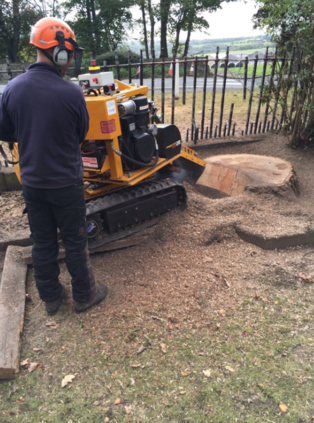
Grinding stays local; full removal digs it all out — the difference
| Stump grinding | Full stump removal | |
|---|---|---|
| What happens to the roots | Surface roots and stump ground to below soil level; deeper lateral roots left in the ground to break down naturally | Entire root ball dug or winched out of the ground |
| Disruption to the garden | Localised — a boarded path in, one hole to backfill | Significant — often needs machinery access and leaves a much larger excavation |
| Typical timeframe | Usually completed within a few hours on site | Can take a full day or more depending on root spread |
| Best suited to | Replanting turf, borders or light planting over the old root position | Sites where you're building, laying a driveway, or need every root physically gone |
| Typical cost | £85-£300 for most garden stumps | Higher, due to extra labour and disposal |
One team for the whole job, not a subcontractor sent in afterward
In a garden like the ones around Southwell, where a grinder might be working inches from a lime-mortared boundary wall or a border that's been dug and replanted for decades, it matters who's actually holding the machine. A lot of tree surgeons fell the tree, then pass the stump off to a separate subcontractor who's never walked the site, doesn't know where the wall footing sits, and has no particular reason to slow down for your fruit trees. Here, the felling if there was any, the grinding, and any root tracking under a path all stay with the same team — working under NPTC certification for chainsaw operation, aerial tree work and rigging, and backed by £5,000,000 public liability cover. George is on every job personally, from taking the call through to walking the finished site with you before he leaves, which in a garden with old brick and mature borders is what keeps a routine grinding job from turning into a repair bill and an awkward phone call.
Where we work, starting with Southwell's Minster streets and orchards
Southwell (NG25) is our focus for this page, particularly the streets close to the Minster and the older residential roads running off Church Street and King Street, where cottage gardens back onto orchard strips that have been there since before the houses were extended. We also cover the newer estates on the edge of town, where gardens are younger but still often planted with a fruit tree or two left in from a previous owner. Beyond Southwell itself we work right across Nottinghamshire, including Ravenshead and West Bridgford, along with Nottingham, Long Eaton, Wollaton, The Park Estate, Beeston, Bramcote, Attenborough, Edwalton, Gamston, Ruddington, Bingham, Arnold, Woodthorpe, Carlton, Mapperley, Hucknall, Derby and Mansfield. If you're outside NG25 but near one of those areas, get in touch anyway — travel between local jobs is normal for us.
Southwell stump questions, answered straight
How much does it cost to remove an old apple or pear tree stump?
Most fruit tree stumps fall in the £120-£250 range, toward the lower-middle of the general £85-£300 garden stump bracket, because apple and pear stumps are usually smaller in diameter than the oaks and conifers that push prices up. Multi-stemmed or old coppiced fruit trees can run higher because there's more than one stem base to grind. A site visit is the only way to get a firm number, since wood hardness and root spread vary a lot between trees that look similar from a photo.
Can you grind a stump in a mature cottage garden border without damaging plants?
Yes, though it takes more care and usually more time than an open lawn job. We use boards to protect the ground either side of the access route, move or shield anything delicate close to the stump, and where a border is genuinely tight we'll use a smaller machine or finish the last section by hand rather than risk catching a nearby shrub or perennial.
How do you remove a stump close to historic garden walls?
We keep the grinder wheel away from the wall face itself and finish that last stretch by hand-tracing the root, rather than letting the machine work right up to the stonework. Older lime mortar and shallow footings can be more vulnerable than they look, so we'd rather take longer on that section than risk the wall.
Is grinding safe near an orchard with other fruit trees nearby?
Generally yes — the grinder only works on the stump being removed, not the surrounding trees. The one thing worth flagging honestly is honey fungus: if the stump being removed was killed by it, grinding alone doesn't treat the disease, and infected root material left in the ground can still be a source for nearby trees. If you suspect fungus we'd rather talk that through with you before starting than grind and say nothing.
How do you track old tree roots that spread under a garden path?
We follow the root visually and by probing the ground either side of the path, then grind out what we can reach from both sides without lifting the paving itself. Roots running directly under slabs are usually left in place to decay naturally rather than lifting the path to chase them, unless you specifically want the path relaid.
Will stump grinding disturb established flower borders?
Grinding itself is localised to the stump and its immediate root plate, so a border a few feet away is rarely affected. The main risk is foot traffic and machine access getting to the stump, which is why we plan the access route with you first rather than just walking the grinder in the shortest way.
Can you remove multiple old orchard stumps at once?
Yes, and it's usually better value than booking them separately — one site visit, one machine mobilisation, and often a lower per-stump price once we're already set up on site. Southwell orchard gardens with three or four old stumps from previous fruit trees are a job we see fairly often.
How deep should grinding go before replanting a fruit tree?
For turf or shallow planting, 4-6 inches below soil level is usually enough. If you're planning to replant a new fruit tree in roughly the same spot, we'd recommend grinding deeper and further out, since a new tree's root system will want to establish in ground that isn't still full of old root fragments and grindings.
Does stump removal near a Minster-area property need special care?
The Minster's conservation area status generally governs the trees themselves — felling, pruning and works to trees above a certain size can need consent — rather than removing a stump from an already-felled tree. That said, we check the specifics for any property inside the conservation boundary before starting, because the safe assumption is to confirm rather than guess.
Get Your Free, No-Obligation Quote
Tell us a bit about the job and we'll come back to you with honest advice and a free quote — usually within 24 hours.
- NPTC-certified operators working under £5,000,000 public liability cover
- Founder George attends personally, from the first phone call to the final check of the site
- Machine sizes matched to the job — narrow-access tracked grinders for tight cottage gardens, not one-size-fits-all kit
Or call 0115-647-2443
Get My Free Quote
Don't let an old stump outlast the tree it came from
An old stump left in a border only gets harder to deal with — roots toughen, suckers spread, and honey fungus risk to nearby fruit trees doesn't improve with time. Get in touch for a site visit and a proper quote before it becomes a bigger job than it needs to be.
Stump Grinding and Stump Removal Services
Call 0115-647-2443