
Tree Risk Assessments Nottingham: Reports for Commercial Grounds and Communal Developments
- NPTC-certified for aerial tree work, chainsaw operation, and rigging/dismantling
- £5,000,000 public liability insurance as standard on every site visit
- Assessed and reported on by founder George personally, start to finish
If you're responsible for a commercial site, a managed estate, or a block of flats with mature trees on the grounds, you'll already know the position you're in: those trees are an asset until the day one of them isn't, and then the question everyone asks is whether you knew about the risk beforehand. Tree risk assessments in Nottingham are how you answer that question properly, with a written record rather than a guess. This isn't a five-minute drive-by look from the road. It's a walkover inspection of every tree on your site (or a representative sample on larger grounds), checked against recognised defect indicators, and written up as a report you can hand to your insurer, your managing agent, or your board when someone asks what's being done about the sycamore leaning over the car park.
We carry out these assessments across Nottingham and the surrounding areas for property factors, landlords, housing associations, and commercial site managers who need something more defensible than "it looked fine to me." The person who walks your site and writes your report is the same person who founded this business on doing the parts of tree work other companies skip, so the report isn't handed off to a subcontractor you've never met.
QTRA and AA Risk Rating: What's Included in the Survey
- Risk categorisation using a named, recognised method - QTRA (Quantified Tree Risk Assessment) or the AA's Common Sense Risk Assessment - so every rating has a defined scoring logic behind it, not a personal impression
- A ground-level visual tree assessment (VTA) of every tree on site, or a defined sample on larger estates, checking the trunk, root flare, crown, and canopy for visible defects
- A written report identifying each tree by location (numbered or mapped where the site warrants it), its condition, and the risk rating it's been given
- Clear recommendations per tree: no action needed, monitor and reassess, prune to reduce risk, or fell
- Photographic evidence of any defects found, so the report stands up if it's later queried by an insurer or a resident
- A recommended reassessment interval based on what the survey finds, rather than a generic annual default
- Zoning of larger sites into target areas (car parks, footpaths, play areas, boundaries) so higher-footfall zones get closer attention than a back corner nobody walks through
Not Included / Costed Separately
- Aerial or climbing inspection to investigate internal decay is not part of a standard walkover survey - it's quoted separately if a tree flags for closer investigation
- Any remedial pruning or felling identified in the report is quoted and carried out as a separate job, not bundled into the report fee
- Root investigation (excavation or trial pits to check root plate condition) isn't included as standard and is only recommended where visible signs point to it
- Drone or LiDAR survey mapping isn't part of the base service - most sites don't need it, but it can be arranged for very large or inaccessible grounds
- A full BS5837 survey for planning or development purposes is a different, more detailed report than a risk assessment and is scoped separately if that's what you actually need
From What Prompts a Survey to the Report Landing on Your Desk
- What triggers the request -- Most surveys start for one of three reasons: an insurance renewal that now asks for evidence of tree management, a specific complaint or near-miss involving one tree, or a new site - an estate you've just taken over managing, or a first survey nobody's ever commissioned. Telling us which one it is, plus a rough tree count and what the ground is used for, shapes how we quote the visit.
- Site walkover -- We walk the grounds tree by tree, checking trunk base, root flare, crown structure, deadwood, cavities, fungal fruiting bodies, and lean, and note the surrounding target area - what's underneath or nearby that a failure would hit.
- Risk categorisation and report drafting -- Each tree gets a risk rating using a recognised method rather than a subjective note, with the reasoning behind it written into the report so it's clear why a tree was flagged or cleared.
- Report delivery -- You get a written report with photos, per-tree findings, recommendations, and a suggested reassessment date - in a format you can pass straight to your insurer, board, or managing agent.
- Remedial work quote (if needed) -- If any trees need pruning or felling as a result of the survey, we quote that as a separate job. Because the same team does the tree work, the stump grinding, and the site clearance, you're not chasing three different contractors to close out one recommendation.
- Reassessment scheduling -- For sites with an ongoing duty of care - housing estates, business parks, communal grounds - we can flag the next assessment date to line up with your insurance renewal or your existing maintenance cycle, so it doesn't quietly lapse.
Report Fees: Single-Tree Pricing vs. Per-Site Estate Rates
A single tree risk assessment and report typically runs to around £300 plus VAT, and standard written reports across the industry generally sit somewhere between £200 and £350 depending on how much detail the report needs to go into. For a site with multiple trees - a housing estate, a business park, or communal grounds - pricing usually moves to a per-site basis rather than a per-tree rate, because a walkover of forty trees on one estate takes a fraction of the time per tree that ten separate single-tree visits would. Site access, tree count, terrain, and how much documentation you need (a simple risk log versus a full report with mapped tree numbers and photos per tree) all affect the final figure. None of this is a fixed rate we can give you over the phone with any honesty - the only accurate quote comes from knowing roughly how many trees you've got and what the site looks like, so the real number always follows a site visit or at minimum a proper conversation about your grounds.
In-House Tree Risk Assessments vs. the Subcontracted Approach
| Assessment carried out in-house | Assessment subcontracted out | |
|---|---|---|
| Who writes your report | The same NPTC-certified person who could carry out any resulting tree work | A third party you may never speak to again once the report lands |
| Follow-up on flagged trees | One team quotes and carries out the pruning, felling, or stump removal directly | You're back to square one finding a separate contractor for the actual work |
| Site knowledge | Continuity across visits - the same eyes see the site each time | Different subcontractor each cycle, no history of what was flagged last time |
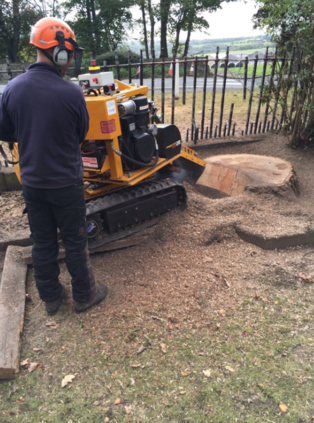
| Stump removal after felling | Handled by the same team as part of the wider service | Often skipped or quoted as an entirely separate job by a different trade |
Reports Insurers Recognise, From the Person Who Walked the Site
George walks every site himself and signs off every report himself. He's NPTC-certified for aerial tree work, chainsaw operation, and rigging and controlled dismantling, and every visit carries £5,000,000 public liability insurance, so the qualifications behind your risk rating are the same ones that would carry out any felling or pruning the report ends up recommending. That continuity is deliberate rather than incidental: the business is structured as three connected divisions - tree services, forestry work, and property maintenance for factors and landlords - built around handling a site canopy to underground rather than passing pieces of it to different trades. George set the company up that way after seeing how often stump removal got left half-finished or quietly subcontracted once a tree was down, and the same logic applies to risk reporting: the assessment isn't a document handed over by someone you'll never see again, it's the opening step with the person who can also act on it. On the paperwork itself, every rating is scored against a named method, QTRA or the AA's Common Sense Risk Assessment, and written up with per-tree photos and a recommended reassessment date, in a format insurers and managing agents are used to accepting rather than a one-off template nobody recognises.
Nottingham Coverage: Local Ground Conditions and TPOs That Shape a Rating
We're based at 20 Prince St in Long Eaton and cover Nottingham as our main patch, along with the surrounding towns and suburbs. That includes The Park Estate, where mature trees on a conservation site often carry Tree Preservation Orders, so any recommendation to fell needs to account for that before work is planned. Wollaton's proximity to Wollaton Park means some domestic and commercial boundaries back onto genuinely old oak and parkland-origin trees, which behave differently under inspection than younger street planting. Attenborough, close to the nature reserve and gravel pit wetlands, tends to have damper ground conditions that affect root stability and are worth flagging in a report rather than assuming standard drainage. Ravenshead and Southwell sit nearer the edge of Sherwood Forest, where you're more likely to be surveying veteran trees with genuine age-related deadwood rather than the younger stock typical of newer estates. Beeston and Bramcote, with a lot of shared and communal residential grounds near the university corridor, are common territory for the kind of estate-wide survey a housing management company would commission. We also cover Long Eaton, West Bridgford, Ravenshead, Edwalton, Gamston, Ruddington, Bingham, Arnold, Woodthorpe, Carlton, Mapperley, and Hucknall, with Derby and Mansfield covered for larger commercial instructions.
Tree Risk Assessment Questions We Get Asked
What actually is a tree risk assessment, and why does it matter legally?
It's a documented inspection that records the condition of trees on a site and the level of risk they pose to people or property nearby. It matters because if a tree fails and causes injury or damage, the question that follows is always whether the owner or manager knew, or should have known, about the risk. A dated, written assessment carried out by someone competent is your evidence that reasonable care was taken - without one, you're relying on memory and goodwill.
How often should a commercial or communal site have one done?
There's no single legal interval, but most sites with a duty of care to visitors or residents work to an annual cycle, with more frequent checks for trees already flagged as needing monitoring, or after severe weather. Veteran or structurally compromised trees might need a six-monthly look rather than waiting a full year. The report itself will usually recommend a specific next date based on what was actually found, rather than defaulting to twelve months regardless of condition.
Do communal residential developments need annual inspections?
Most managing agents and housing associations treat annual as the working standard, largely because it lines up with insurance renewal and gives a consistent paper trail. It's not a fixed statutory requirement in every case, but if trees are close to communal walkways, parking, or play areas, going longer than a year without a check is a hard position to defend if something does go wrong in the gap.
What's the difference between a quick walkover check and a detailed diagnostic assessment?
A walkover (sometimes called a Level 1 or Level 2 assessment depending on the framework used) is a visual inspection from ground level across the whole site, picking out anything that needs closer attention. A detailed diagnostic assessment (Level 3) is a much closer, tree-specific investigation - often involving tools like a resistograph or sonic tomography to check internal decay - and it's only used on individual trees the walkover has already flagged as a concern. Most sites only need the detailed level applied to a handful of trees, not the whole estate.
What is QTRA or the AA risk assessment method, and does it matter which one is used?
QTRA (Quantified Tree Risk Assessment) and the AA's Common Sense Risk Assessment are both recognised, structured methods for turning what an arborist observes into a defensible risk rating, rather than a personal judgement call. Which method is used matters less than whether a recognised method was used at all - it's the difference a court or insurer will actually look for if a report is ever challenged.
How much does a tree risk assessment cost for a commercial site in Nottingham?
A single tree assessment typically runs to around £300 plus VAT, with standard reports generally landing between £200 and £350. Multi-tree sites are usually priced per site rather than per tree, since a walkover covering many trees in one visit works out considerably cheaper per tree than pricing each one as a separate single-tree job. The only way to get an exact figure is from a site visit or a proper conversation about tree count and site layout.
What happens if a tree is found to be dangerous during the inspection?
If something poses an immediate risk - active failure, a hanging limb, a lean that's changed recently - we'll flag it to you straight away rather than waiting for the full written report to be finished, so you can restrict access to that area if needed. The report will then set out exactly what work is recommended, and we can quote that work separately.
Can a tree risk assessment protect a landlord or factor from liability claims?
It puts you in a much stronger position if a claim follows a tree failure. It doesn't make you immune to a claim if a tree does fail, but it demonstrates you took reasonable, documented steps to identify and manage the risk, which is what liability arguments usually turn on. What it can't do is protect you if a report is done and then its recommendations are ignored - the paper trail cuts both ways.
Could a rolling assessment schedule be built around our insurance renewal dates rather than a fixed calendar date?
Yes, and it's often more useful than a rigid annual date - if your insurance renews in March, having the assessment land in February means the report is fresh when your insurer or broker asks for it, rather than eight months stale. We can set reassessment recommendations to match a housing association's or landlord's actual renewal cycle rather than defaulting to the anniversary of the last visit.
Get Your Free, No-Obligation Quote
Tell us a bit about the job and we'll come back to you with honest advice and a free quote — usually within 24 hours.
- NPTC-certified for aerial tree work, chainsaw operation, and rigging/dismantling
- £5,000,000 public liability insurance as standard on every site visit
- Assessed and reported on by founder George personally, start to finish
Or call 0115-647-2443
Get My Free Quote
Get Your Site's Trees on Record Before Someone Else Asks Why They Weren't
If your last tree inspection was informal, out of date, or never actually happened, that's the gap an insurer or a claim finds first. Get in touch to talk through how many trees you've got and what the site looks like, and we'll set out what an assessment and report would involve for your grounds.
Stump Grinding and Stump Removal Services
Call 0115-647-2443