
Commercial Stump Grinding Nottingham for Construction Sites, Golf Courses and Public Parks
- In-house from felling to final grind, so a site isn't juggling a tree surgeon and a separate stump subcontractor
- NPTC-certified operators working under £5,000,000 public liability cover
- Founder George involved personally from the first site call through to the final walk-round
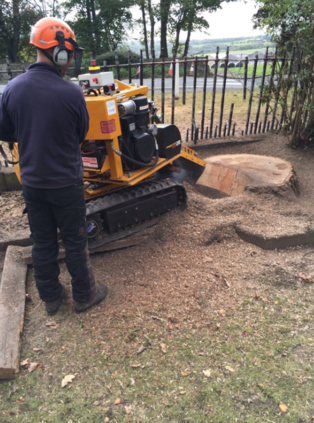
When a housing developer, groundworks contractor, golf club or parks team needs stumps cleared at scale, commercial stump grinding Nottingham jobs call for different machinery and different logistics from the domestic side of the trade. A garden disc grinder towed behind a car will bog down after two or three large stumps. A construction site with thirty root balls scattered across a build platform, or a golf course with fairway-edge stumps that need clearing without tearing up turf, needs tracked, high-horsepower machines and a crew used to working to a programme rather than a homeowner's afternoon.
This business started out grinding stumps that other tree surgeons left behind after felling, and that origin still shapes how larger sites get handled: the stump is never treated as an afterthought handed off to whoever's free that week. If a site also needs trees felled, pruned or managed before the grinding starts, that work sits under the same roof rather than a different supplier's diary, so there's one point of contact from canopy to below ground.
What's in scope when a grinding contractor comes onto a live site
- Grinding of large or multiple stumps across development plots, golf courses and park land, including root balls left behind by a principal contractor's own felling crew
- Below-grade grinding to the depth a site actually needs, whether that's shallow for grass reinstatement or deep enough to clear a footing or hardstanding, not just a surface skim
- Tracked, high-horsepower grinders able to work soft ground, banks and areas a towed domestic machine can't get near
- Root flare and buttress root grinding around stumps close to boundary walls, kerbs or existing structures
- Clearing of surface roots that would otherwise catch a mower, roller, or foundation excavator further down the programme
- Site-specific RAMS and toolbox talks where a principal contractor's health and safety plan requires them
- Working in phases across a site as different plots or holes become accessible, rather than needing the whole area handed over at once
Not Included / Costed Separately
- Full stump excavation with a digger, where the whole root ball is pulled out of the ground rather than ground down - that needs different plant and usually causes more disruption to surrounding ground
- Locating or diverting underground utilities - if services aren't already marked on site, that's for the client or their groundworks contractor to arrange before grinding starts
- Ecological surveys - where a park or site shows signs of protected species near old stumps, that survey has to be commissioned separately before any grinding is booked in
- Backfilling the resulting hole with topsoil or reinstating turf or tarmac over it - this can be arranged as an add-on but isn't included automatically
- Hauling the resulting mulch and chippings off site - by default it's left graded flat for the client to use or arrange disposal of, though removal can be quoted if wanted
- Felling of standing trees - handled in-house but priced and scheduled as its own piece of work, not bundled silently into a grinding quote
How a multi-stump site actually gets worked, from enquiry to handover
- Initial scope call -- A conversation about how many stumps, what size, what the site is (build plot, course, park land), current access, and any programme deadline. For multi-stump development sites, a plot list or site plan speeds this up considerably.
- Site visit and survey -- George or a senior operator walks the ground to check access widths for tracked machinery, obstacles like drainage runs or landscaping already installed, and what's been marked for services. On a golf course or park, this is also when ground pressure and turf protection get discussed.
- Paperwork and scheduling -- RAMS, site inductions and any permits - verge licences, TPO conditions, park byelaws - are sorted before a date is fixed. On a live construction site, the grinding slot gets agreed against the wider programme so it doesn't sit on anyone's critical path.
- Mobilisation -- High-horsepower tracked grinders arrive on site along with protection matting where turf, paving or buried cabling needs shielding from the machine's tracks.
- Grinding -- Stumps are ground to the agreed depth, working plot by plot or hole by hole rather than trying to cross an entire site in one pass, so finished areas can be handed back and used while the rest continues.
- Sign-off -- The site is walked with whoever's managing it, chippings are graded or bagged as agreed, and any snags - a hole needing extra depth, a stump missed off the original count - are dealt with before the crew leaves.
Day-rate pricing and what actually drives the cost on a site
Domestic stump removal in the UK typically runs somewhere between £60 and £600 per stump depending on diameter and root spread, but that per-stump pricing model doesn't map well onto a commercial job. Once you're grinding a dozen stumps across a build plot, or clearing every dead tree stump along a fairway, the job is priced per day or per site rather than per stump, because the real cost drivers are different: how many machines and operators the site needs, how far apart the stumps are spread, ground conditions and access, whether turf or paving protection is needed, and whether the work has to fit around an active build programme or opening hours. A site with thirty stumps in a cleared, flat plot with good access can often be worked through faster per stump than a handful scattered across a live course between rounds of golf. Because of that spread, a figure given without seeing the site would be a guess rather than a quote - the reliable way to price a commercial job is a site visit, which is free and doesn't commit you to anything.
Plant, pricing and paperwork: how a commercial job differs from a garden one
| What matters | Garden or domestic stump removal | Commercial stump grinding |
|---|---|---|
| Typical machine | Small towed or walk-behind grinder | Tracked, high-horsepower self-propelled grinder |
| Job scale | One stump, occasionally a handful | Multiple stumps across a plot, course or park |
| Pricing basis | Priced per stump | Quoted per day or per site after a site visit |
| Paperwork | Rarely needed beyond a quote | RAMS, site induction and permits as standard |
| Scheduling | Fitted around a homeowner's diary | Fitted around a live build programme or course opening hours |
| Ground protection | Not usually a factor on a small garden | Matting or routing planned in advance to protect turf, paving or buried services |
Why commercial clients choose this crew for site-wide grinding
Working on a live construction site, a public park or a golf course means fitting into somebody else's schedule and safety framework, not the other way round. RAMS get written for the actual site, toolbox talks happen before anyone starts a machine, and if a principal contractor's own safety officer wants a walk-round before work begins, that's built into the day rather than treated as a delay. £5,000,000 public liability cover as standard means a site manager can sign a grinding contractor onto a live job without a separate insurance argument.
George stays personally involved in scoping commercial work, from the first call through to agreeing access routes and ground protection on the site visit. That matters more on a commercial job than a domestic one, because a misjudged access route or an unprotected drain run can turn into real cost and real delay on a live programme - getting it right at the scoping stage is what keeps a multi-stump site running to plan.
Where commercial site work is covered
Commercial and site grinding work is covered across Nottingham and the wider area, including construction sites and new-build developments in West Bridgford, Beeston, Attenborough and Carlton; golf courses around Ravenshead and Mansfield; and park or estate land in Southwell, Bingham, Arnold, Woodthorpe and Mapperley. Sites at Wollaton, The Park Estate, Gamston, Edwalton, Bramcote and Hucknall are also within easy reach, along with commercial jobs further out toward Derby and Mansfield. If a site sits outside this list, get in touch anyway - multi-site or larger contracts are often still worth a call.
Commercial Stump Grinding FAQs
Can a tracked grinder work on soft ground without damaging it?
Tracked machines spread their weight over a much wider footprint than a wheeled towed grinder, which is part of why they are used on golf courses and park land. Where ground is particularly soft or turf needs extra protection, matting is laid along the working route as standard rather than as an extra.
Why is commercial work priced per day rather than per stump?
Once a job involves multiple stumps spread across a site, the real cost driver is how long the crew and machine are on site, not how many individual stumps get ground. A day-rate or per-site quote reflects that more accurately than trying to price each stump separately.
How is grinding kept safe around buried utilities on a site?
Where services are marked on site drawings or by the client utility survey, grinding depth and position are planned around them before the machine starts. If there is any doubt about what is beneath a particular stump, that is flagged before work begins rather than found out mid-grind.
Can grinding be scheduled around an active construction programme?
Yes, the grinding slot is agreed against the wider build programme during the paperwork and scheduling stage, and work is often phased plot by plot so finished areas can be handed back and used while the rest of the site continues.
Can grinding be done on a golf course or park without closing it to the public?
In most cases, yes, grinding is planned around opening hours or tee times, working hole by hole or area by area so the rest of the course or park stays in use. This gets agreed with the club or parks team during the site visit.
What happens to the chippings and debris after grinding?
By default, the resulting mulch and chippings are graded flat across the hole for the client to use or arrange disposal of. Removal off site can be quoted as an add-on where a site would rather it was taken away.
What paperwork will be provided for a site file?
Site-specific RAMS and evidence of five million pounds public liability cover are provided as standard for any job that needs them, along with toolbox talk records where a principal contractor health and safety plan requires sign-off.
Is bulk or multi-site work available for developers with several plots?
Yes, developers and contractors with several plots or sites across the area can have grinding scheduled across all of them under one arrangement rather than booking each site separately. Get in touch to talk through the scope and timing.
Does a park or public site need an ecological survey before grinding?
Where old stumps show signs of use by protected species, such as bats or nesting birds, a survey should be commissioned before grinding is booked in. This is not something included in a grinding quote, but it is flagged during the site visit if there is any indication it is needed.
Request a Site Visit
Tell us about your site - plots, holes, or area to be cleared - and we'll arrange a free, no-obligation visit to scope the job properly.
- In-house from felling to final grind, so a site isn't juggling a tree surgeon and a separate stump subcontractor
- NPTC-certified operators working under £5,000,000 public liability cover
- Founder George involved personally from the first site call through to the final walk-round
Or call 0115-647-2443
Get a site visit booked in for your grinding job
Whether it's a handful of stumps on a build plot or a full site clearance, get in touch for a free, no-obligation site visit.
Call 0115-647-2443