
Property & Estate Tree Maintenance Nottingham
- NPTC-qualified for aerial tree work, chainsaw use and rigged dismantling, so every job on your estate is signed off to the same standard
- £5,000,000 public liability cover as standard — useful when a factor's insurer or managing agent asks for proof on file
- One in-house team handles pruning, felling and stump grinding, so there's no subcontractor gap between what's agreed and what's actually done on site
A block of flats, a housing estate, or a commercial site with mature trees on it doesn't get much out of a one-off tree surgeon quote — by the time you're back in the market for another one, nobody on site can tell you what was done last time or why. Property and estate tree maintenance in Nottingham means something different in practice: a standing arrangement rather than a single visit, with visits booked in on a set cycle, a written record kept for your insurers, and someone who already knows the site and picks up the phone when a limb comes down over a car park at 7am on a Monday.
We hold these contracts for property factors, housing associations and commercial landlords across Nottingham and the towns around it. The business itself grew out of stump grinding — the job most tree surgeons leave behind or hand to a subcontractor — and expanded into full tree work once existing clients started asking the same team for pruning and felling. Every visit on an estate contract is NPTC-qualified work, carried under £5,000,000 public liability cover, with founder George involved from the first call through to the final site check.
Inspection Cadence, Pruning Cycles and Emergency Cover on Your Contract
- Scheduled inspection of communal and boundary trees on a rolling cycle, timed to fit an agreed calendar or a factor's own planned preventative maintenance dates
- Formative and reductive pruning to keep canopy clear of roofs, windows, parking bays, street lighting and footpaths
- Deadwood removal and hazard-branch reduction on trees that are otherwise sound
- Felling of any tree that's become unsafe, diseased or structurally unstable, followed by grinding the stump out below grade so there's no trip hazard or regrowth left on communal grass or paving
- Cutback of shared boundary hedges and shrubs affecting sightlines, access routes or neighbouring plots, where this is agreed as part of the contract
- Storm and emergency call-outs for fallen or hanging branches on communal land, with a make-safe visit ahead of the full remedial work
- A written report with photographs after every visit, filed to support a factor's insurance and maintenance audit trail
- Liaison with the local council on Tree Preservation Order or conservation area consent before protected trees are touched
Not Included / Costed Separately
- Trees inside individually let gardens or demised plots — these need separate instruction from the leaseholder or a specific variation added to the contract
- Formal arboricultural survey reports for planning applications (the kind a BS5837 survey covers) — can be arranged but quoted and invoiced separately from routine maintenance
- Replanting or wider soft landscaping beyond making good the ground where a stump has been ground out
- Any work on a TPO or conservation area tree ahead of council consent being granted — we hold works back until that's confirmed
- Root-related drainage problems needing jetting or root barriers — flagged but referred to a drainage specialist
From Site Walk-Round to a Fixed Inspection Calendar
- Initial call and estate walk-round -- You talk through the site with George directly, then we walk the estate together, mapping every communal tree by species, condition and access, and flagging anything already leaning, deadwooded, or covered by a TPO.
- Written proposal and inspection schedule -- You get a proposal setting out inspection frequency, the works list, and a visit calendar — this can be built around your own planned preventative maintenance dates and asset software if you already run one, so it doesn't sit as a separate system.
- First visit clears the backlog -- The opening visit usually deals with anything already overdue — deadwood, storm damage, an unstable stump left by a previous contractor — so the site starts the contract at a proper baseline rather than catching up mid-cycle.
- Scheduled visits to the agreed calendar -- Routine pruning, hedge cutback and any felling and stump grinding happen on the dates set out in the schedule, not on an ad-hoc basis, so costs and site disruption are predictable.
- Reporting after every visit -- You get a written report and photographs after each visit, which goes on file for your own records and for insurers or auditors who want evidence the trees were actively managed.
- Emergency and reactive cover between visits -- Storm damage or a resident's report of a hanging branch gets a response outside the normal schedule, agreed at contract stage, so you're not left waiting for the next planned date.
Budgeting for Scheduled Visits Rather Than One-Off Call-Outs
There isn't a single published rate for estate tree contracts anywhere in the trade — every arborist quotes them bespoke, because the price depends on tree count, condition, access, and how often you want visits. As a general steer, UK hedge and tree maintenance labour tends to run somewhere between £30 and £120 an hour depending on scope and access, which is a reasonable proxy for what a single visit's labour might cost before you factor in equipment, waste removal or stump grinding. For an ongoing contract, most factors and landlords prefer either a fixed annual sum spread across scheduled visits, or per-visit invoicing against the agreed works list — both are workable, and we can set the invoicing to match a service charge budgeting cycle so you're not hit with a mid-year surprise. None of this replaces an actual figure: the only way to get one that means anything is a site visit, so George can see the tree stock, access and condition for himself before pricing the contract.
One Team, One Record: Why Felling and Stump Work Stay With the Same Crew
Every visit on an estate contract ends with the same thing landing in your inbox: a dated report and photographs you can hand straight to a managing agent, an insurer, or your own board without chasing anyone for it first. That paperwork habit isn't an add-on — it's built around what factors and landlords actually get asked for when a claim comes in or a service charge gets audited, which is proof the trees were looked at, not just a memory of someone having been on site.
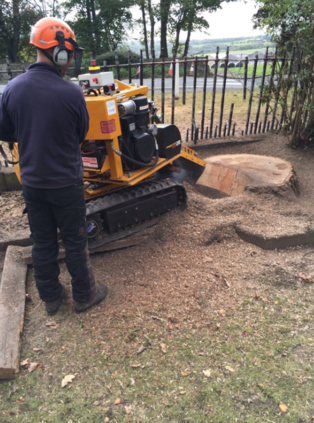
The reason one team handles both the felling and the stump grinding on these contracts, rather than splitting the work between a tree surgeon and a separate ground-out contractor, goes back to how the business started. George began by taking on the part of the job other tree surgeons routinely skipped — grinding out the stump once a tree was down — and built a reputation on finishing that part properly. Clients who'd had a stump dealt with started asking for the pruning and felling too, and the work grew from there into the three strands the business runs today: tree services, forestry work, and property maintenance for factors and landlords. NPTC certification covers the aerial work, the chainsaw use and the rigged dismantling that estate trees often call for, and every contract carries £5,000,000 public liability cover, with George involved personally from the walk-round through to the final sign-off.
The difference shows up clearest against the two other ways this work usually gets done. Call an ad-hoc tree surgeon for felling and the stump is often left behind — grinding it out was never part of the original quote, so it becomes a second job booked separately, or it doesn't happen at all. Go through a contractor who does offer stump grinding but subcontracts it out, and you're back to two visits, two invoices and two different reports to file, with the felling and the stump work often landing weeks apart. On one of our contracts the same team fells the tree and grinds the stump on the same visit, a written report and photographs come from one visit rather than two, storm response is built into the agreement rather than depending on who happens to be free that day, and where you're managing more than one site, visits can be routed across nearby developments to bring the callout cost down. Whoever you speak to on the phone, meet on site, or hear back from afterwards is the same person throughout: George, from the first call to the final site check.
Estates and Developments Currently on Our Rolling Schedule
We're based at 20 Prince St in Long Eaton, which puts us within easy reach of Nottingham, our main patch for estate and factor work, as well as Attenborough and Long Eaton itself, where several of the newer cul-de-sac developments sit close to the nature reserve boundary and its established tree cover. In West Bridgford, a fair amount of the estate work involves managing mature street trees on the verges of the Edwardian avenues, where root growth and pavement clearance are as much a factor as canopy size. The Park Estate, with its private tree-lined roads managed through a residents' association rather than the council, is a different kind of site again — works there typically need sign-off through that association before we start. Wollaton and Bramcote both have pockets backing onto older woodland edges, which means a higher proportion of mature specimens needing deadwood management rather than young formative pruning. Out towards Ravenshead and Southwell, on the fringe of Sherwood Forest, tree stock tends to be older oak and beech on sandy, free-draining ground, which changes how root plates behave in high wind and is worth flagging to any factor managing a rural-edge site. Newer developments around Gamston and Edwalton usually have younger street trees and communal open space still establishing, which is a different maintenance pattern again — mostly formative pruning rather than remedial work. We also cover Beeston, Ruddington, Bingham, Arnold, Woodthorpe, Carlton, Mapperley and Hucknall, and take on multi-site contracts further out into Derby and Mansfield for housing associations managing more than one development.
Questions Factors and Landlords Ask Us Before Signing
What is included in an ongoing tree maintenance contract for a housing estate?
The core of it is scheduled inspection, pruning, deadwood removal, and felling with stump grinding where a tree needs to come out, plus written reporting after every visit. Hedge and boundary shrub cutback is often added too. The exact list is agreed at the site walk-round and set out in the proposal, so you're not paying for anything that isn't relevant to your estate.
How often should communal trees on a housing development be inspected?
A formal inspection once a year is a reasonable minimum for most estates, with more frequent checks — every six months or so — where you've got a lot of mature trees close to buildings, parking or play areas. On top of the scheduled visits, it's worth having an informal visual check after any named storm, which we can build into the contract as a standing response rather than something you have to remember to ask for.
Do property management companies need a tree maintenance contract by law?
There's no single law that forces you to hold a contract, but factors and landlords carry a duty of care to keep communal land reasonably safe for residents and visitors, and that duty gets tested hard if a tree causes injury or damage and there's no record it was ever inspected. A documented maintenance contract is the practical way most factors meet that duty and give themselves something to point to if a claim comes in.
What happens if a tree on communal land is damaged in a storm?
Under a contract, storm damage gets a make-safe visit first — clearing anything hanging or blocking access — followed by the full remedial work once it's safe to plan properly. You get a written report and photos from the visit, which is what most insurers want to see alongside a claim for storm damage.
How do commercial landlords budget for annual tree care?
Most landlords prefer either a fixed annual sum spread across the scheduled visits, or invoicing per visit against the agreed works list. Either can be timed to line up with your service charge budgeting cycle, so tree care shows up as a predictable line rather than an unplanned cost partway through the year.
Can a maintenance contract cover multiple sites for a housing association?
Yes — several developments can sit under one contract, and where sites are close together we can route visits to cover more than one on the same day, which tends to bring the per-site callout cost down compared with booking each development separately.
What's the difference between reactive and planned tree maintenance?
Planned maintenance is the scheduled inspection and pruning cycle that catches problems early, before they become hazards. Reactive maintenance is what happens after something's already gone wrong — storm damage, a resident's complaint, a subsidence concern. A contract that only covers reactive call-outs tends to cost more over time than one that includes planned visits, because problems get caught later and bigger.
Who is liable if a poorly maintained tree causes damage on rented property?
Responsibility generally sits with whoever is responsible for maintaining the land the tree stands on — usually the landlord or the managing party, not the tenant, unless the lease says otherwise. It's worth checking your own management agreement rather than assuming, but a documented maintenance contract is good evidence that reasonable care was being taken if the question ever comes up.
Do estate tree contracts include hedge and shrub maintenance too?
Often, yes, for shared boundary hedges and shrubs that affect sightlines or access routes, but it's not automatic — it's agreed as a specific line item in the contract rather than assumed to be bundled in. Worth raising at the walk-round if it's something your estate needs.
Get Your Free, No-Obligation Quote
Tell us a bit about the job and we'll come back to you with honest advice and a free quote — usually within 24 hours.
- NPTC-qualified for aerial tree work, chainsaw use and rigged dismantling, so every job on your estate is signed off to the same standard
- £5,000,000 public liability cover as standard — useful when a factor's insurer or managing agent asks for proof on file
- One in-house team handles pruning, felling and stump grinding, so there's no subcontractor gap between what's agreed and what's actually done on site
Or call 0115-647-2443
Get My Free Quote
Get Your Estate or Site Onto a Proper Schedule
Storm season and insurance renewals have a way of arriving at the same time as an overdue tree. If your estate, block or commercial site is still being managed one call-out at a time, a walk-round with George costs you nothing and gives you a proposal you can actually put in front of your board or your insurer. Call to arrange a site visit and get a schedule in place before the next storm makes the decision for you.
Stump Grinding and Stump Removal Services
Call 0115-647-2443