
Emergency Tree Surgeon Nottingham: 24/7 Storm Damage Response
- NPTC-certified for aerial work, chainsaw use and rigged dismantling
- £5,000,000 public liability cover on every emergency call-out
- Founder George hands-on from your first call to the final site check
When a gale comes through Nottingham and a tree ends up across your drive, leaning on the roof, or hanging over the fence into next door's garden, the questions that matter aren't about pruning schedules — they're "is this safe right now" and "who can get here today". That's what an emergency tree surgeon in Nottingham is for: making a dangerous situation safe first, then dealing with the tree itself, whether that's a full removal, a controlled section-by-section take-down, or bracing something that's leaning until calmer conditions allow a proper job.
You'll be dealt with by NPTC-certified operatives covering aerial tree work, chainsaw operation, and rigging and controlled dismantling, working under £5,000,000 public liability cover, with founder George involved from your first call through to the final check that the site's left safe. Because stump removal is where this business started, a storm-felled tree that's come out roots and all can be ground out on the same visit rather than being left as a job for someone else to book separately later.
On-site, this is what gets sorted
- Making a hung-up or partially snapped branch safe (a "widow-maker" caught in the crown or resting on another limb)
- Cutting a fallen or windblown tree off a roof, car, fence, driveway or road so access is restored
- Sectional dismantling of a snapped, split or badly leaning trunk using rigging rather than a straight felling cut where there's no room to drop it
- Temporary bracing or roping to stabilise a leaning tree until full work can be scheduled in daylight or calmer wind
- Clearing the debris directly created by the emergency work from the immediate hazard area
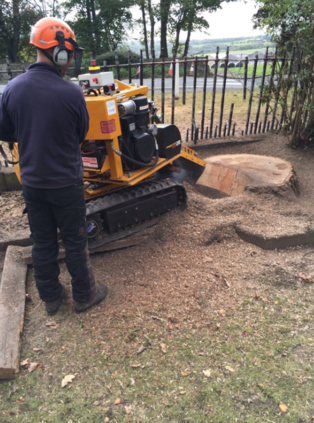
- Grinding the stump out on the same visit if the tree has come over with its root plate, rather than leaving it as a separate job
Not Included / Costed Separately
- General garden or storm debris clearance beyond the tree itself, or skip hire for it
- Structural repairs to a damaged roof, fence, wall or vehicle
- Handling your insurance claim directly (though a written report and photos can be provided for it)
- Any cutting near a tree in contact with live power lines until the network operator has confirmed the supply is isolated
- Felling licence applications for non-emergency work on the same tree afterwards
- Replanting or grounds restoration once the hazard is cleared
From the phone call to a clear driveway
- Phone triage -- You describe what's happened and where — tree on a car, branch over a path, trunk leaning towards a window — so the danger level can be judged before anyone sets off. This is what decides whether it's a same-day or overnight response versus something that can wait for a normal daytime appointment.
- Priority dispatch -- Jobs blocking a road, threatening an occupied building, or sitting over a driveway that someone needs to use get moved to the front of the queue ahead of lower-risk work.
- On-site risk check -- Before any cutting starts, the crew checks for power lines, the direction and load of the lean, ground stability under the root plate, and current wind conditions — storm-felled trees are rarely as stable as they look propped against a fence or another tree.
- Make safe or remove -- Depending on what's found, that means roping and rigging a controlled dismantling, a straight sectional removal, or bracing to buy time until it's safe to finish the job properly in better light or calmer weather.
- Clear the hazard area -- Cut material is cleared from the road, driveway or path so access is restored — the immediate priority — rather than a full garden tidy at that point.
- Stump and follow-up -- If the root plate came up with the tree, it's ground out there and then rather than left half-finished. Where more work is needed once things have calmed down, a written quote and photos for your insurer are left with you.
What drives the price of a storm call-out
Emergency tree call-outs across the UK typically start from around £400, with the final figure driven by the scale of the storm damage — a single hung branch is a different job to a mature tree down across a road with rigging and a road closure involved. Out-of-hours and weekend response usually carries a higher rate than a daytime booking, reflecting the mobilisation involved in turning a crew out at short notice. Access matters too: a tree that's come down in an open front garden costs less to deal with than one wedged against a house or over a boundary fence where rigging and careful sectional lowering are needed instead of a straight drop. None of this replaces an actual figure for your situation — a call to talk through what's happened, and in most cases a site visit, is what gets you a firm price rather than a guess.
Emergency crew vs. booked-in tree work
| What matters | Emergency call-out | Standard scheduled tree work |
|---|---|---|
| Response time | Same-day or out-of-hours where there's a genuine hazard | Booked appointment, typically days to a couple of weeks ahead |
| Stump left behind | Ground out in-house on the same visit if it came over with the tree | Often quoted or subcontracted separately by other firms, adding a second job and a wait |
| Who's on site | NPTC-certified operative for aerial, chainsaw and rigged dismantling work | Varies firm to firm — worth checking before you book anyone |
| Insurance cover | £5,000,000 public liability as standard | Ask directly — not every firm quotes a specific figure |
| Typical trigger | Storm damage, hung or snapped branches, blocked access, a leaning trunk | Planned pruning, felling, hedge work, or ongoing forestry and grounds contracts |
Why the certifications matter most when a tree's already down
A storm-damaged tree behaves differently to a healthy one waiting for a routine prune. A trunk that's split but still standing, or a branch hung up in a neighbouring crown, is already carrying stress in ways that can shift the moment a cut is made — which is exactly why the NPTC tickets on this job cover aerial work, chainsaw operation, and rigging and controlled dismantling as three separate disciplines rather than one general qualification. Freeing a hung branch safely is a different skill to felling a stable tree, and lowering a section of split trunk under load calls for rigging know-how a straight felling cut doesn't need. That's backed by £5,000,000 public liability cover on every call-out, storm or otherwise, so if a job turns out more complicated on site than it sounded on the phone, the cover is already in place rather than something to sort out afterwards. George takes the triage call himself to judge how urgent a job actually is, and comes back to check the site before the crew leaves — on a job that starts with "is this safe right now", having one person accountable for both ends of it is worth more than it might sound.
How far we'll travel for a genuine emergency
Nottingham is the main patch, with the base at 20 Prince St in Long Eaton putting a crew within quick reach of Beeston, Attenborough and Chilwell as well as the city itself. That matters for a genuine emergency, where the difference between a ten-minute drive and a forty-minute one is the difference between a road staying blocked through rush hour or being clear before it. Further out, storm response also covers West Bridgford and Wollaton, and The Park Estate, where mature trees line conservation-area streets — emergency work there is normally exempt from needing prior tree preservation order consent, but the council still needs notifying afterwards, which is worth knowing if a TPO tree comes down on your property. Towards the edge of Sherwood Forest, Ravenshead and Southwell tend to see more established woodland and larger garden trees exposed to wind than the tighter city plots. The service also reaches Bramcote, Edwalton, Gamston, Ruddington, Bingham, Arnold, Woodthorpe, Carlton, Mapperley and Hucknall, plus Derby and Mansfield for storm response beyond the immediate Nottingham area. Call to check reach for your postcode if you're near the edge of this patch — a fast answer on that beats a wasted trip either way.
Storm damage and fallen trees: your questions answered
What should I do immediately if a tree falls on my house during a storm?
Get everyone out of the affected rooms and keep them out — don't go up into a loft or bedroom to check the damage yourself. If anyone's trapped, or the tree has brought down a power line, call 999 first. Once people are safe, call an emergency tree surgeon to get the tree made safe, and take photos from outside at a safe distance for your insurer before anything is moved.
How quickly can you get someone out to an emergency in Nottingham, including at night if a tree's blocking a road?
It depends on what's described on the phone. A tree blocking a road, sitting on an occupied building, or over the only access to a property gets prioritised and can mean a same-day or overnight response. Something less urgent, like a branch resting safely in an otherwise stable crown, is more likely to be booked as a normal daytime job.
Will my home insurance cover the cost of emergency tree removal after a storm?
Usually yes if the tree has damaged insured property such as a roof, fence or car, but it depends on your policy — check it or call your insurer to confirm before assuming. If a tree simply came down in the garden with no damage to a structure, cover is less likely, though many insurers still want it dealt with promptly. Keeping the invoice and a description of the work helps either way.
Is it safe to remove a fallen or hanging branch myself before you arrive?
Not if it's hung up, under tension, or resting against another branch — that's exactly the setup that causes a sudden drop with no warning. Keep people and pets away and treat it as off-limits. Clearing small twigs or leaf debris off a path is fine; anything still attached or wedged in the tree is a job to leave alone.
What counts as a genuine emergency versus something that can wait for a normal appointment?
Immediate danger to people, property or access counts as an emergency — a leaning trunk over a path, a branch hanging above a drive you need to use, or a tree across a road, car or roof. A snapped limb held securely in an otherwise sound crown, with nothing underneath it, is usually safe to book in as standard work rather than treat as urgent. If you're not sure, describing it on the phone is the quickest way to find out.
What happens if the tree has come down on or near power lines?
No cutting starts near a tree in contact with live cables until the network operator (your local distribution company) has confirmed the supply is isolated. Report it to them directly as well as calling for tree work — the two get coordinated rather than one waiting on the other unnecessarily.
If a storm-damaged tree falls across the boundary between two neighbouring gardens, who pays for the emergency work?
As a general rule, whoever owns the tree — meaning whose land the base and roots are on — is responsible for it, even if it falls the other way across a fence. In a genuine emergency, though, making it safe comes first and the cost question gets sorted afterwards between the parties and their insurers. This isn't legal advice for a disputed boundary; if ownership isn't obvious, your insurer or a solicitor is the right next call alongside ours.
Can you provide documentation my insurer will accept as proof the work was urgent?
Yes — dated photos of the damage, a written description of the hazard, and an invoice detailing the work carried out can all be provided and are the kind of evidence insurers typically ask for. What we can't do is guarantee how your specific insurer will assess or approve a claim, since that's down to their process, not ours.
Get Your Free, No-Obligation Quote
Tell us a bit about the job and we'll come back to you with honest advice and a free quote — usually within 24 hours.
- NPTC-certified for aerial work, chainsaw use and rigged dismantling
- £5,000,000 public liability cover on every emergency call-out
- Founder George hands-on from your first call to the final site check
Or call 0115-647-2443
Get My Free Quote
A leaning tree won't wait for daylight
A leaning or hung-up tree doesn't get safer by leaving it overnight — wind, rain and its own weight keep working on whatever's already failed. If you've got a storm-damaged tree, a branch that's come loose, or anything blocking access to your property in or around Nottingham, get in touch and describe what you're looking at. You'll get a straight answer on how urgent it is and how soon someone can be with you, not a call-back queue.
Stump Grinding and Stump Removal Services
Call 0115-647-2443